

# How AI is Transforming Quality Assurance in Customer Service
The integration of artificial intelligence (AI) into quality assurance (QA) processes is revolutionising customer service. By enhancing efficiency, accuracy, and compliance, AI is setting new standards for customer interactions. This article explores how AI is reshaping quality assurance in customer service, offering insights into tools, techniques, and best practices.
## The Role of AI in Quality Assurance
AI quality assurance is redefining how businesses evaluate and improve customer service. By automating routine tasks and providing deep insights, AI enables companies to maintain high standards while reducing costs.
### Automation and Efficiency
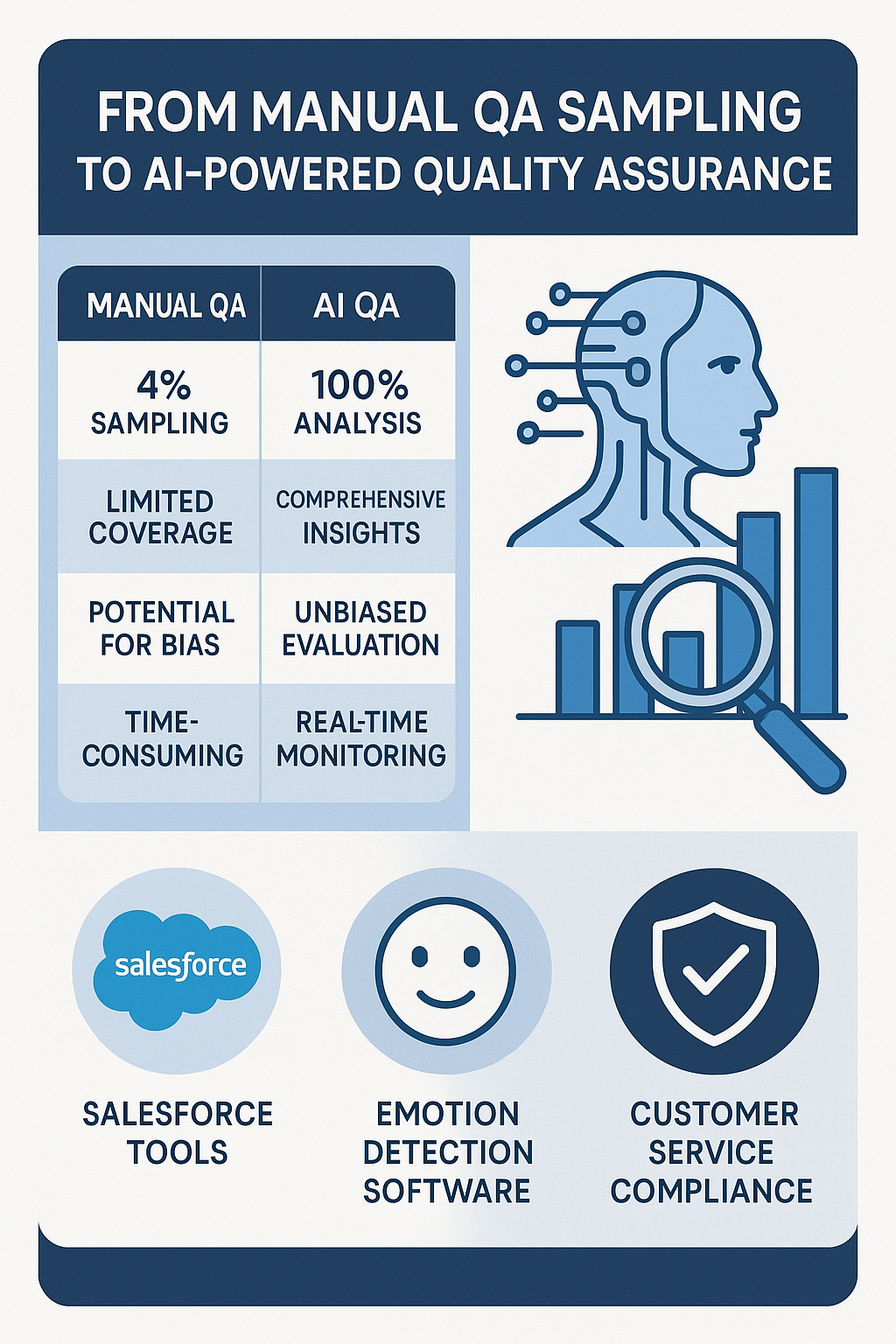
AI-driven tools automate repetitive tasks, such as monitoring calls and analysing customer interactions. This automation allows human agents to focus on complex issues, improving overall efficiency. AI quality assurance systems can process vast amounts of data quickly, identifying patterns and trends that might be missed by human analysts.
### Enhancing Accuracy
AI ensures greater accuracy in quality assessments by eliminating human biases. Machine learning algorithms evaluate interactions based on predefined criteria, ensuring consistent and objective analysis. This precision helps businesses maintain high-quality customer service and identify areas for improvement.
## Leveraging Salesforce QA Tools
Salesforce QA tools are at the forefront of integrating AI into customer service. These tools offer robust solutions for managing and improving customer interactions.
### Comprehensive Monitoring
Salesforce QA tools provide comprehensive monitoring capabilities, allowing businesses to track customer interactions across multiple channels. By integrating AI, these tools can analyse conversations in real-time, offering immediate feedback and insights.
### Customisable Solutions
Salesforce offers customisable QA solutions that cater to specific business needs. Companies can tailor these tools to align with their unique customer service goals, ensuring that AI quality assurance is both effective and relevant.
## Ensuring Customer Service Compliance
Compliance is a critical aspect of customer service, and AI plays a vital role in ensuring adherence to regulations and standards.
### Real-Time Compliance Monitoring
AI systems can monitor interactions in real-time, ensuring that agents adhere to compliance guidelines. By flagging potential violations immediately, AI helps businesses address issues before they escalate.
### Documentation and Reporting
AI tools provide detailed documentation and reporting capabilities, making it easier for companies to demonstrate compliance. These reports can be customised to meet specific regulatory requirements, simplifying the audit process.
## Emotion Detection Software: Understanding Customer Sentiment
Emotion detection software is an innovative application of AI in quality assurance. By analysing vocal tones, language patterns, and facial expressions, this technology provides valuable insights into customer sentiment.
### Improving Customer Experience
Understanding customer emotions allows businesses to tailor their responses, enhancing the overall customer experience. Emotion detection software can identify dissatisfaction early, enabling proactive measures to resolve issues.
### Training and Development
Emotion detection insights can be used to train customer service agents. By understanding how emotions impact interactions, agents can develop skills to manage challenging situations effectively.
## Practical Insights for Implementing AI in Quality Assurance
Implementing AI in quality assurance requires careful planning and execution. Here are some practical insights to guide businesses in this transformation.
### Define Clear Objectives
Before integrating AI, businesses must define clear objectives for their quality assurance processes. Understanding what they aim to achieve with AI will guide the selection of tools and strategies.
### Invest in Training
Training is essential to maximise the benefits of AI quality assurance. Employees must understand how to use AI tools effectively and interpret the insights they provide. Ongoing training ensures that staff remain up-to-date with the latest technologies and methodologies.
### Monitor and Adjust
AI systems require continuous monitoring and adjustment to remain effective. Businesses should regularly review their AI quality assurance processes, making necessary adjustments to align with changing customer needs and regulatory requirements.
## The Future of AI in Customer Service Quality Assurance
The future of AI in quality assurance is promising, with ongoing advancements in technology and methodologies. As AI continues to evolve, businesses can expect even more sophisticated tools and techniques to enhance customer service.
### Integration with Emerging Technologies
AI will increasingly integrate with other emerging technologies, such as blockchain and the Internet of Things (IoT), to provide more comprehensive quality assurance solutions. These integrations will offer new opportunities for innovation and efficiency.
### Personalisation and Customisation
AI will enable greater personalisation and customisation in customer service. By analysing individual customer preferences and behaviours, AI can tailor interactions to meet specific needs, enhancing satisfaction and loyalty.
In conclusion, AI is transforming quality assurance in customer service by enhancing efficiency, accuracy, and compliance. By leveraging tools like Salesforce QA and emotion detection software, businesses can improve customer interactions and maintain high standards. As AI technology continues to advance, the potential for innovation in quality assurance is limitless, offering exciting opportunities for businesses to excel in customer service.